

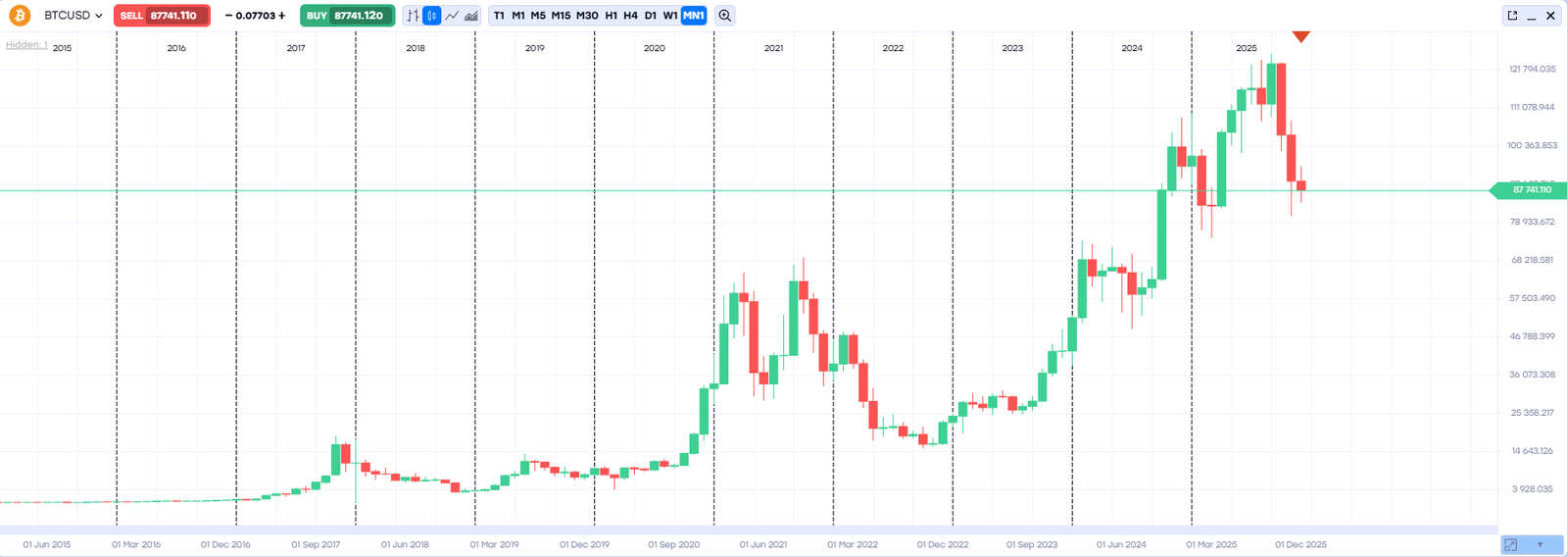
How MSCI influenced MicroStrategy and led to the fall of BTC
 ParadTrade
What MSCI offers
-
MSCI is considering introducing a new rule: companies with more than 50% of their balance sheet assets in cryptocurrencies (or digital assets)could be excluded from its global stock indexes
-
Goal: To identify such companies as “treasury-crypto” (companies whose primary business is the custody of crypto assets) because their business model is closer to investment funds than to operating corporate companies.
-
The consultation will close by the end of 2025, with a decision expected around 15 January 2026.
If the rule is adopted, companies falling under it will be excluded from indices like MSCI USA, MSCI World and others. This will entail a mechanical outflow of funds from index and passive funds, which are required to hold shares included in the indices.
Why is this critical for MicroStrategy (MSTR)
-
MicroStrategy is one of the largest public holders of cryptocurrencies (Bitcoin in particular), and the share of cryptoassets on its balance sheet significantly exceeds 50%.
-
This makes it a prime candidate for exclusion under the new MSCI rule.
-
Analysts (including from JPMorgan) warn that the exclusion of MSTR could trigger an outflow of passive investments by approximately $2.8 billion.
-
If other index providers (e.g. Russell, etc.) adopt similar changes, potential sales could reach $8.8 billionand more.
-
For MSTR, this creates serious pressure: reduced liquidity, reduced demand for its shares, a potential drop in capitalization, and increased difficulty in raising new capital, which is especially critical for its Bitcoin strategy.
How this could affect Bitcoin and the cryptocurrency market
-
MSTR shares previously provided many institutional and retail investors with “indirect exposure” to Bitcoin through traditional stock markets. Excluding MSTR from indexes will cut off this channel.
-
If MSTR (and similar companies) begin to sell their BTC in order to reduce the share of crypto assets and remain in the indices, this could provoke waves of sales in the cryptocurrency market. Some analysts warn that such a “forced sell-off” could put pressure on the price of BTC.
-
This fear increases volatility and increases uncertainty in the market: potential sales, “panic” sales, decreased confidence in “treasury” models with cryptocurrencies.
How did it affect MSTR and traders’ sentiment
-
Immediately after the news about the possible exclusion of MSTR from the indices, the company’s shares were under pressure: many investors and funds began fixing positions, fearing forced sales.
-
There have been outbursts of indignation in the crypto community: some participants are calling for a boycott of traditional institutions that promote the rule, and believe that this is an attempt to limit the spread of BTC through the capitalization of classic companies.
-
Many investors have begun to rethink how reliable the “treasury + Bitcoin” strategy is for public companies – skepticism and demand for more “transparent” instruments (ETFs, funds, the crypto storage itself) are growing, rather than through shares of companies whose balance sheet is held in crypto.