
Santa Claus Rally: Why Markets Often Rise at Year-End
 ParadTrade

At the end of the year, U.S. stocks often show jumps, providing higher returns to investors. But there is a special trend known as the “Santa Claus Rally,” which covers the last five trading days of the calendar year and the first two new years, bringing particular benefits to traders.
Over the past two decades, the S index&The P 500, a barometer of U.S. stock performance, has increased by an average of 0.7 percent per year over those seven trading days. In addition, the S index&The P 500 was positive for those seven days in 15 of 20 years — or 75% of the time.

Understanding Santa Claus Rally
Part of this trend is due to simple seasonality: since 1950, the S-index&The P 500 rose 70 percent of the time, from Thanksgiving to New Year’s Eve, by an average of 1.7 percent.
Researcher Yale Hirsch first documented this pattern in 1972, writing in the Stock Trader’s Almanac that the S index&The P 500 added an average of 1.5% over that seven-day period from 1950 to 1971.
Rally Santa Claus became not just a good name for a frequent phenomenon, but an indicator of the coming year for the stock market. Hirsch tracked three similar indicators as performance indicators next year: the Santa rally, the first five days of the market in the new year, and the January barometer – or market performance in the first month of the year. The first of them became the most famous.
Why is there a Santa Claus Rally? Trading volume tends to be low as institutional investors leave the week after Christmas. The market can be more volatile and have a greater impact on retail investors, who tend to be more optimistic.
Investors are buying stocks ahead of an expected gain in January known as the January effect, which could result from reinvesting money after collecting tax losses in December.
The week between Christmas and New Year can inspire hope and optimism for the coming year, and year-end bonuses and gifts during the holidays give people the opportunity to invest in the stock market.
The paradox of rallying
The main feature of the Santa rally is that it can occur even in periods of recession.. In 2018, the S index&The P 500 ended the month with a 6.6 percent rise after December 24, which were the last four trading days of the month. Despite this, the index fell on January 3, the second day of the new year.
Similarly, in 2008, during the stock market crash caused by the financial crisis, stocks actually got a Santa Claus rally in the middle of a larger bear market rally. Over a seven-day period, the S index&The P 500 added 7.5 percent, though it collapsed again in the first two months of 2009 and then bottomed on March 9.
In both 2008 and 2018, the Santa Claus rally successfully predicted bull markets for the coming year. In 2009, the broad market index rose 23%; in 2019, it rose 29%.
However, this phenomenon is not always an accurate predictor of next year’s earnings. In 2021, the S index&The P 500 gained 1.4 percent over the seven-day period, but the market peaked on Jan. 3 and entered bearish momentum in June, falling more than 20 percent as the Federal Reserve Board aggressively raised interest rates.
As we mentioned, during this seven-day trading period, the S-Index&The P 500 rose 1.3 percent on average.For comparison, the yield S&The P 500 as a whole was much lower at 0.24% for all other seven-day trading periods since 1950. Stocks were positive 58% of the time during those periods.
December tends to be one of the strongest months of the year for U.S. stock performance. Since 1926, only yields in July and April have exceeded the December average of about 1.9% and 1.7% versus 1.6%, respectively.
Should we expect a Santa Claus rally this year?
This season, there are reasons to think so.. Stocks end week after Thanksgiving upbeat: Dow Jones industrial index up 1.3 percent, S index&The P 500 is up 1 percent and the Nasdaq Composite is up 0.9 percent.
There seems to be some real momentum behind the stock market that could turn the Thanksgiving rise into a full-blown year-end rally.
But the potential rally is more than purely technical. Fundamentally, we are now witnessing the end of the Federal Reserve tightening cycle. The central bank last raised interest rates in July and the market is coming to the conclusion that it was the latest hike in this rate hike campaign.
This is good news for the S index.&The P 500, which averaged 17% over the year. Given that the S index&The P 500 has remained virtually unchanged since the Fed’s last interest rate hike in July, suggesting the index has a lot to fix.
Rate cuts could be problematic if the Fed acted to prevent a recession, but the good news is that the US economy is in good shape. November U.S. Business Activity Index by S&P Global Flash, a measure of economic activity in the manufacturing and services sectors, was 50.7 – a sign that economic growth is at its best, while inflation continues to fall.
Which companies are most affected by the Santa Claus Rally?
Christmas is a time of holiday shopping and we increasingly prefer to buy gifts in a few clicks online. Consequently, stocksAmazonThey definitely win an advantage during the New Year rally. Not only is Amazon a leading online retailer, but it remains the No. 1 player in cloud computing services through its AWS platform.
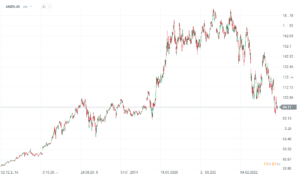
Also, the increase in sales traffic due to the holiday shopping hype favors companies that provide services based on non-cash transactions, such as:PayPal.
Do not underestimate the factory of children’s dreams. CompaniesDisneyThey own some of the most valuable media objects in the history of the Marvel Cinematic Universe and Star Wars, which love to watch for the holidays.
In addition, the leading manufacturer of graphics processorsNvidiaThe rally may be of particular interest in this regard, as chips are key to some of the biggest trends in computing today, including artificial intelligence and cloud computing.
Outcomes
Stocks typically rise over the last five days at the end of the year and the first two days of the following year. Judging by the results since 1994, the behavior of stocks during the Santa rally is also usually an accurate predictor of the direction of the stock market for the next year.
It is a mistake to confuse correlation with causation. The fact that the Santa rally often predicts the market’s success for next year doesn’t mean it will continue later. The mood of traders can change.
However, investors need to know how the market moves at different times of the year. While there are no clear expectations for a Santa rally, history has shown that stocks often perform better at the end of the year.